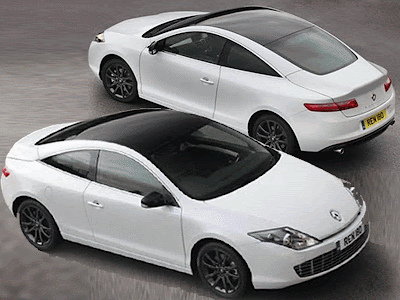
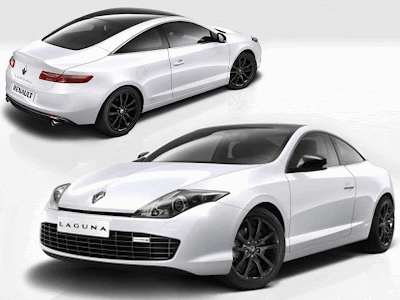
Post by: AutomotiveNew Mégane R.S. is the latest addition to Renault's line-up of sporting vehicles and stands out from
the other models that make up the Mégane range through its styling and performance which live up
every bit to the newcomer's sporty pedigree.
In response to customer demand, New Mégane R.S. is available from launch with a choice of two
chassis: the Sport chassis, for everyday driving pleasure, and the Cup chassis, for even more exhilarating track-focused performance.
New Mégane R.S. is powered by a 2.0-litre turbocharged petrol engine. Peak power is 250hp, while
maximum torque stands at 340Nm which is available across a particularly broad rev-band to deliver
a standard of performance that can be enjoyed equally on the road and on race tracks.
New Mégane R.S. boasts a raft of specific equipment designed to heighten driving enjoyment,
including R.S. Dynamic Management (which permits three ESP modes) and R.S. Monitor (onboard
telemetry).
New Mégane R.S. is manufactured at Renault's Palencia plant in Spain, on the same production
lines as those of the hatchback, coupé and estate versions of New Mégane.
Dialled-in performance
New Mégane R.S. is the latest in a series of emblematic models that have helped forge Renault
Sport's reputation, from the R8 Gordini to Mégane R26.R.
Assertive, sporty looks
Racy exterior and interior styling of New Mégane R.S. takes inspiration from the world of motor
sport.
Technologies that make a real contribution to travelling comfort and performance
o Two technologies developed for even greater driving enjoyment: R.S. Dynamic
Management (three ESP modes) and R.S. Monitor (onboard telemetry).
o A raft of equipment usually associated with cars from the next segment up.
Driving pleasure in all situations
o A choice of two chassis: the standard Sport chassis and the Cup chassis featuring an
optional limited slip differential.
o The 2.0 Turbo R.S. engine: 250hp and maximum torque of 340Nm
o Powerful brakes with four-pot Brembo front callipers.
Safe sports performance
New Mégane R.S. benefits from Renault's massive expertise in the fields of active and passive
safety.
New Mégane R.S. features in the latest version of 'Need for Speed' video game: 'Need for
Speed Shift'
Renault and motor sport: more than one hundred years of success
The current economic situation and manufacturing strategy
New Mégane R.S. profits from the expertise acquired by Renault's Palencia plant in Spain with the
New Mégane programme.
DIALLED-IN PERFORMANCE
Renault has been a major player on the international motor sport scene for many years. The R8 Gordini, the Super 5 GT Turbo, Clio Williams and, more recently, Clio Renault Sport, Mégane F1 Team R26 and Mégane R26.R have all stood out as emblematic ambassadors for the brand on race tracks and rally stages around the world. The current range of production Renault Sport-badged models benefits extensively from Renault Sport Technologies' long experience of competition and from the Renault group's manufacturing expertise.
With more than 21,000 units sold in some 30 countries since its 2004 launch, Mégane Renault Sport has been a resounding success. In addition to topping its class in France, Mégane Renault Sport is one of the most competitive hot hatches around thanks to refinements that have been introduced over the years, including the availability of the even more efficient Cup chassis, as well as the release of the radically lightened R26.R version. Both Mégane F1 Team R26 and Mégane R26.R are acclaimed for their high performance engines and chassis efficiency. They were each voted 'Sporting Car of the Year' by readers of the French magazine Echappement in 2007 and 2008 respectively. Meanwhile, Mégane R26.R – which still holds the lap record for its class round Germany's 21km Nürburgring Nordschliefe circuit – was named 'Car of the Year' by the British mag Evo and stands out as the benchmark hot hatch of its class.
THE STUNNING LOOKS OF A THOROUGHBRED HOT HATCH
New Mégane R.S. features the same styling cues as New Mégane Coupé, but it also exudes a distinctly sporty feel thanks to several elements that take their inspiration from Formula 1. The dynamic, sweeping lines of the coupé version combine with a number of details which recall the world of motor sport to give it an even more assertive character, while pointing to the promise of exhilarating on-road performance:
- the wheelarches are wider to accommodate the impressive 18- or 19-inch wheels,
- the front bumper incorporates a wide air intake and a Formula 1-type aerodynamic blade,
- the central exhaust tailpipe, diffuser and rear lip spoiler reaffirm the car's sporting credentials and contribute to its aerodynamic performance,
- the front bumper-mounted LED daytime running lights highlight the car's piercing gaze.
New Mégane R.S.'s stance is uncompromisingly sporty – a sensation reinforced by its striking launch
colour, Sport Yellow – while at the same time exuding a distinct impression of robustness and stability. Special attention has been paid to quality, too, as illustrated by the design and finish of the 19-inch Steev wheels which suggest a cocktail of refinement, advanced technology and speed. The exterior mirror housings, the aerodynamic blade incorporated in the front bumper and the rear diffuser are all picked out in gloss black, a further sign that New Mégane R.S. is not only sporty but also chic and elegant.
BEAUTY WITHIN, TOO!
The cabin carries over the chic, sporty styling of the exterior, and features a dark charcoal trim which
contrasts with the Sport Yellow rev-counter background and steeringwheel stitching. The Yellow Ambience Pack brings further touches of colour in the form of the seatbelts and two-tone grey and yellow upholstery, as well as the door-panel and gear lever knob stitching.
The driving position is unmistakably sporty, but also perfectly comfortable. The front seat back and
cushions feature additional lateral support, while the driver's seat is fully adjustable (fore/aft adjustment =240mm, height adjustment = 70mm), including adjustable lumbar support. The heated leather seats come with an electric settings-memory function. Those owners who enjoy putting their vehicle through its paces round a circuit will appreciate the optional cloth- or leather-upholstered Recaro seats which are also height- and fore/aft-adjustable.
The low seating position is comfortable, and the driver benefits from efficient support, whether driving on the open road or negotiating a racetrack.
The steeringwheel, too, is designed to be comfortable and sporty. It is trimmed in full-grain leather and is both height- and reach-adjustable to find the ideal driving position. Its shape and integrated thumb rests ensure perfect grip, while the yellow centre-point marking is a particularly useful feature when taking a sequence of tight corners or when driving on low-grip surfaces.
The competition feel of the driving experience is rounded off by the aluminium-faced pedals and footrest. Quality materials have been employed, while special care has been paid to assembly excellence and to the smaller details, with Renault Sport-badging visible on the grille, tailgate, sills, headrests, rev-counter background and dashboard trim.
COMFORT- AND PERFORMANCE-ENHANCING EQUIPMENT
New Mégane R.S. benefits from a raft of technological equipment, including:
- automatic dual-zone climate control with three modes (Soft/Auto/Fast),
- hands-free card with automatic door locking as the card-holder walks away from the vehicle,
- the 3D Sound by Arkamys audio system, with standard RCA connection or optional Plug & Music
connectivity (USB, jack).
- a choice of two navigation systems: Carminat Bluetooth DVD® or Carminat TomTom®.
The analogue instruments of New Mégane R.S. are specific to the model and are another feature which provides a visible tie-in with the world of motor sport. In addition to the warning light which recommends the ideal moment to change gear, an audible warning also tells the driver when the rev-limiter is about to cut in.
A new feature on New Mégane R.S. is the Renault Sport Dynamic Management system which allows
the driver to choose the degree of electronic aid he or she wants in different situations:
- 'On': the default mode when the engine is fired up. The ESP, ASR traction control and emergency brake assist are all activated. The system intervenes as soon as it senses that the car is on the verge of sliding. The pedal mapping ensures smooth acceleration, making this mode ideally suited to everyday use.
- 'Sport' mode, for less intrusive ESP action. This mode is selected by a short press on the ESP button. Although the ESP and ASR are still active, they intervene at a later point and allow the car to slide to a certain extent, so long as the skid doesn't exceed a given threshold. The pedal mapping is modified to permit swifter engine response.
- 'Off' mode, for unfettered enjoyment, notably round a circuit. This mode is activated by a longer push on the ESP button. The electronic stability programme is fully disconnected, while the pedal mapping is modified to permit swifter engine response.
When the latter two modes are selected, the mentions 'ESP Sport' or 'ESP Off' are visible on the dashboard display.
COMPETITION-STYLE DATA-FEEDBACK
Another unprecedented new feature for New Mégane R.S.'s class is the Renault Sport Monitor, an
advanced tool which provides the driver with real-time data. The system takes its inspiration directly from technology employed in motor sport and, until now, seen only on a small number of prestige road cars.
The R.S. Monitor is an electronic system which enables driving data to be collected via an array of
sensors. Drivers can scroll through the system's different functions using the steeringwheel remote
controls, and the following information is shown of the main dashboard display:
data concerning the main engine functions (turbo pressure, oil temperature) and brakes,
real-time engine performance data (torque, power),
transverse and longitudinal acceleration ('GG' display),
stopwatch, with memory function,
performance data, with automatic memorisation of best 400-metre standing start and 0-100kph times.
The R.S. Monitor also enables the driver to modify the pedal mapping. A choice of five settings is
available with the 'Sport' mode selected ('linear', 'normal', 'snow', 'sport' and 'extreme') in order to adapt the car's acceleration characteristics to the conditions or to the driver's wishes of the moment.
EFFICIENT PERFORMANCE AND DRIVING ENJOYMENT IN ALL SITUATIONS
New Mégane R.S. benefits from the extensive work that went into the chassis of Mégane R26.R, including independent steering axis front suspension coupled with a programmed-deflection rear torsion beam.
In response to customer demand, New Mégane R.S. is available with a choice of two chassis:
- the Sport chassis, which delivers the ideal balance between sports performance and everyday driving comfort,
- the Cup chassis which, combined a limited slip differential, delivers outstanding traction, particularly appealing to owners looking to enjoy themselves round a circuit.
Independent steering axis front suspension (R.S. Performance Hub) was first seen on a Renault
production car in 2004, with the launch of Mégane Renault Sport. This arrangement ensures stable front suspension geometry under hard acceleration or when applying a significant amount of steering lock, cutting torque-steer.
Compared with the first-generation layout which it supersedes, New Mégane R.S.'s front suspension has benefited from significant work into reducing unsprung weight. The pivot, pivot carrier, and lower arm which links the wheel assembly to the engine subframe are made from aluminium, while ball joints
are now employed between the pivot and pivot carrier to reduce the forces to which the steering axis is
subjected.
For optimal directional precision, the front suspension is attached to a so-called 'horned' subframe, a layout which ensures a level of transverse rigidity which is three times superior to that of Mégane II Renault Sport's front suspension.
Meanwhile, the damper housing and shaft diameters have been uprated on New Mégane R.S. compared with Mégane coupé. This has doubled the stiffness of the strut and optimizes maintenance of the front wheels' geometry under load.
The programmed-deflection rear torsion beam uses a new closed-profile beam which ensures the
same level of stiffness for less weight.
The Sport chassis benefits from specific damper and spring ratings. The diameter of the front anti-roll bar is 23mm, while the stiffness of the axis is 19mm/100DaN at the front and 25mm/100DaN at the rear.
Compared with New Mégane Coupé TCe 180, New Mégane R.S.'s anti-roll performance is improved by
12.5 per cent.
The Cup chassis with limited slip differential: uncompromising performance
The Cup chassis is aimed at enthusiasts who enjoy sporty driving and fans of track days, since its specific settings truly come into their own when the car is pushed that little bit harder. Compared with the Sport chassis, anti-roll stiffness has been increased by 13 per cent thanks to a bigger-diameter anti-roll bar (24.2 mm). The dampers are specific, too, while axis stiffness has been uprated by 35 and 38 per cent at the front and rear respectively compared with the Sport chassis. Anti-roll stiffness at the rear has been increased by 7 per cent compared with the Sport chassis.
The overall anti-roll stiffness of the Cup chassis marks an improvement of 15 per cent over the Sport
chassis.
Equipped with a limited slip differential (LSD), Mégane R.S. Cup chassis delivers genuine competition-type performance. The LSD ensures optimum traction at all times; whatever the conditions, however much grip is available, whatever the diving style and whatever the type of corner. The combination of a limited slip differential and independent steering axis front suspension minimizes the effects of torque steer and permits the driver to profit fully from the extra traction for a more reassuring drive.
The limited slip differential also ensures greater stability under braking. By kicking in immediately, it pushes back the threshold when the ASR traction control intervenes under hard acceleration or when the ESP cuts in when turning into corners, thereby freeing the car’s full braking potential. Improved turn-in performance also means that the driver is able reaccelerate harder and sooner.
In short, in addition to improving the efficient transmission of power to the road, and thereby enhancing
performance, the limited slip differential delivers progressive, reassuring handling which is appreciable
whatever the driving style.
Lateral cornering stability has been improved to obtain a remarkable specific angle of roll, namely
0.31°/m/s 2 in the case of the Sport chassis and 0.28°/m/s 2 for the Cup chassis (compared with an average of 0.38°/m/s 2 for New Mégane Coupé, and 0.35°/m/s 2 for Mégane II F1Team R26).
It is easy to spot when New Mégane R.S. is equipped with the Cup chassis and limited slip differential
thanks to its red brake callipers and grooved brake discs.
18- or 19-inch tyres
The following tyres are standard for New Mégane R.S.:
- Sport chassis: the new Dunlop SP Sport Max TT (225/40 R18 Y),
- Cup chassis: Michelin Pilot Sport 2 (235/40 R18 Y), also fitted to R26.R
A 19-inch option is available for both chassis, namely the new Continental Sport Contact 5 Performance
(CSC5P) (235/35 R19 Y).
Exceptionally powerful brakes
High-performance cars call for high-performance braking systems that deliver both bite and resistance to fade. New Mégane R.S. benefits from exceptional stopping power thanks to its four-pot Brembo callipers and 340mm diameter vented discs at the front, the biggest available in the hot hatch segment. The front discs are grooved in the case of the Cup chassis equipped with a limited slip differential. Braking performance is further enhanced by an 11-inch servo.
At the rear, New Mégane R.S. is equipped with 290mm-diameter discs (again, grooved in the case of the Cup chassis).
Sport-style steering
New Mégane R.S.'s electric power steering features the same changes introduced on New Mégane,
although its calibration has been adapted to suit the new model's sportier calling. The system delivers
more precise feedback, with a progressive increase in turning effort into corners and enhanced comfort
through turns. Its steering ratio of 14.75:1 is closer than that of the former-generation version.
ENJOYABLE ENGINE PERFORMANCE
One of New Mégane R.S.'s major strengths is to be found underneath the bonnet in the form its newgeneration, Euro5-compliant 2.0 16V turbocharged engine (F4Rt). This powerplant delivers peak power of 250hp (184kW) at 5,500rpm and maximum torque of 340Nm at 3,000rpm, for a specific power output of 125hp/litre.
This increase in power and torque has notably been achieved thanks to:
- evolution changes to the turbo for even enhanced response at low revs,
- continuously variable intake valve timing,
- revised fuel-injection mapping.
With 80 per cent of peak torque available from as low as 1,900rpm, acceleration is smooth and responsive thanks to the twin scroll turbocharger and continuously variable intake valve timing.
To guarantee both performance and reliability, more than 25 per cent of the engine's components are new compared with the 230hp version which powers Mégane F1 Team R26:
- new intake ports,
- reinforced reciprocal parts (pistons and conrods),
- new air/air and water/oil intercoolers,
- sodium-cooled valves,
- piston ring carriers.
New Mégane R.S.'s engine drives through a six-speed manual gearbox (PK4). Compared with the
version of this gearbox mated to New Mégane's TCe 180 engine, the ratios are taller with increased shift precision to give a sportier feeling. This new transmission enables the engine's inherent performance to be exploited, with a 0-100kph time of 6.1 seconds and the 1,000-metre standing start covered in 25.7 seconds.
New Mégane R.S. returns excellent fuel economy for this level of power, with combined cycle fuel
consumption of just 8.4 litres/100km, equivalent to CO2 emissions of 195g/km.
New Mégane R.S. is also equipped with a system designed to optimize standing start performance. Known as Power Start, this system functions when the car is at a halt – with ESP selected – and allows the driver to profit fully from the engine's acceleration performance without grip being lost.
Work on the intake ports and exhaust has also bestowed New Mégane R.S. with a telltale sporty pitch
under hard acceleration.
Reliability, durability and endurance
To ensure lasting performance, Renault Sport Technologies' development team has put the New Mégane R.S. through its paces in a wide variety of situations, from long-distance circuit runs to extreme cold and heat, covering more than 300,000km in teasting.
Sporting performance in complete safety
Renault considers safety to be a priority and a domain in which the brand is known to excel. Renault uses the findings of LAB (Accident Analysis, Biomechanics and Human Behaviour Laboratory of PSA Peugeot-Citroën and Renault) to design vehicles which are both safe and adapted to real-world driving conditions.
New Mégane R.S. naturally benefits from Renault's expertise in this field.
A raft of equipment is included to help drivers anticipate or avoid risk:
- seatbelt warning lights for all five seats,
- tyre pressure monitoring system,
- bi-Xenon directional headlamps,
- automatic headlamp activation,
- automatic windscreen-wiper activation,
- cruise control with speed limiter,
- ESP with understeer control,
- emergency brake assist.
New Mégane R.S.'s outstanding passive safety performance has been achieved thanks to the same
systems which enabled New Mégane Hatchback to obtain the maximum five-star EuroNCAP crash
test rating and the maximum possible score of 37 points from 37.
The programmed deformation of New Mégane R.S.'s structure has been engineered to absorb impact
energy to protect the cabin and its occupants. The materials employed – including high, very high and
very, very high elastic limit steels – have been selected to absorb and dissipate as much kinetic energy as possible. Controlled deformation ensures that occupants are subjected to lower deceleration forces and this, coupled with the third-generation Renault System for Restraint and Protection (SRP3), guarantees an extremely high level of protection.
New Mégane R.S. features in the latest release of Electronic Arts’ 'Need for Speed' video game
series: 'Need for Speed Shift'
Following the successful inclusion of New Mégane Coupé in 'Need for Speed Undercover' which was
released last November, Renault and Electronic Arts have continued their association with the appearance of New Mégane R.S. in 'Need for Speed Shift', the latest addition to the NFS series which went on sale in September.
Need for Speed's development team were won over by the looks and performance credentials of New
Mégane R.S., and have featured it in the game's line-up of 70-car line-up which that includes the most
legendary models of the past three-and-a-half decades.
Renault's experts and developers from Electronic Arts worked hand-in-hand for almost a year to make New Mégane R.S.'s role in the game as lifelike as possible.
Need for Speed Shift delivers driving sensations on a par with those felt behind the wheel of the cars
themselves, and its unique gameplay features provide players with an unparalleled experience as they
embark on a tour of the world's most legendary circuits.
Created 15 years ago, Need for Speed evolves from year-on-year, enabling players to enjoy the thrills of motor racing with increasing realism. More than 100 million copies of Need for Speed have been sold, making it the biggest motor racing video game franchise ever thanks to its combination of prestigious cars and incomparable technical qualities and graphics. The game is developed and published by Electronic Arts, the world's leading video game publisher, whose products constantly strive to push out the envelopewhen it comes to innovation, player immersion and intensity.
THE ECONOMIC SITUATION AND PRODUCTION STRATEGY
Europe continues to enjoy a buoyant hot hatch market which increased threefold between 2001 and 2008 to grow from 10,700 to 32,800 units. The United Kingdom and Germany account for 60 per cent of total European sales.
The current year is expected to produce contrasting results, marked by a significant downturn during the
first half of the year (down 40 per cent). However, there is a strong correlation between sales and the
models available on the market, and volumes are likely to pick up in the course of the second half of 2009
as the majority of the competition's models are renewed (about 10 new models in total).
New Mégane R.S. is manufactured at the Palencia plant in Spain on the same lines as the New Mégane
range. Specific investment was spent at the factory to permit the R.S. version to be built on the main
production line.
The bulk of this investment covered acquisition of the necessary assembly tools for body components such
as the front and rear wings, engine subframe, seats, specific wheels and exhaust.
All the operators at the Palencia plant received specific training. Their programme included the fitment of
exterior accessories, assembly of the independent steering axis front suspension and installation of the
Recaro seats.
New Mégane R.S. benefits from same enhanced quality that is a hallmark of the entire New Mégane
range.
15
RENAULT AND MOTOR SPORT – A CENTURY OF SUCCESS
1899: victory for Louis Renault in the Paris-Ostend road race
1900: victory for Louis Renault in the Paris-Toulouse-Paris road race
1901: Renault monopolizes the top-three places in the Paris-Bordeaux road race
1906: victory in motor racing's first ever Grand Prix (Grand Prix de l'ACF)
1971: Formula Renault 2.0 created
1977: Renault makes Formula 1 debut
1978: the A442b wins the Le Mans 24 Hours
1982: the Marreau brothers win the Paris-Dakar rally in a Renault 20
1986: launch of the Renault Super 5 GT Turbo
1989: launch of the Renault 19 16V
1993: rally debut of Renault Clio Maxi and launch of Renault Clio Williams
1995: launch of Renault Sport Spider and creation of the Renault Spider Trophy (circuit racing)
1996: rally debut of Renault Maxi Mégane
1999: creation of the Renault Clio V6 Trophy (circuit racing)
2000: launch of Clio II Renault Sport and Clio V6 Renault Sport
2002: rally debut of Renault Clio Super 1600
2003: creation of Formula Renault V6 (circuit racing)
2004: launch of Mégane II Renault Sport
2005: creation of the Renault Mégane Trophy and Formula Renault 3.5 (circuit racing)
2005 and 2006: Renault wins the Formula 1 Constructors' world title
2006: launch of Clio III Renault Sport
2007: creation of the Renault Clio Cup (circuit racing) and launch of Renault Clio R3 / R3 Maxi (rallying)
2007: Mégane Renault Sport F1 Team R26 voted 'Sporting Car of the Year' by readers of the French magazine Echappement
2008: launch of Twingo II Renault Sport
2008: Mégane Renault Sport R26.R voted 'Sporting Car of the Year' by readers of the French magazine Echappement, and voted 'Car of the Year' by the British magazine Evo
2009: creation of the New Renault Mégane Trophy (circuit racing)
2009: launch of New Mégane Renault Sport
source : Renault Press